No items found.
5 min read ・
February 19, 2026
Download release

Two years ago, suggesting that Hubject would connect a million vehicles charging without apps, cards, or payment screens across North America would have sounded optimistic. The technology existed, but scaling it across fragmented networks, competing standards, and hundreds of stakeholders seemed like the kind of coordination problem that takes decades to solve.
It didn't.
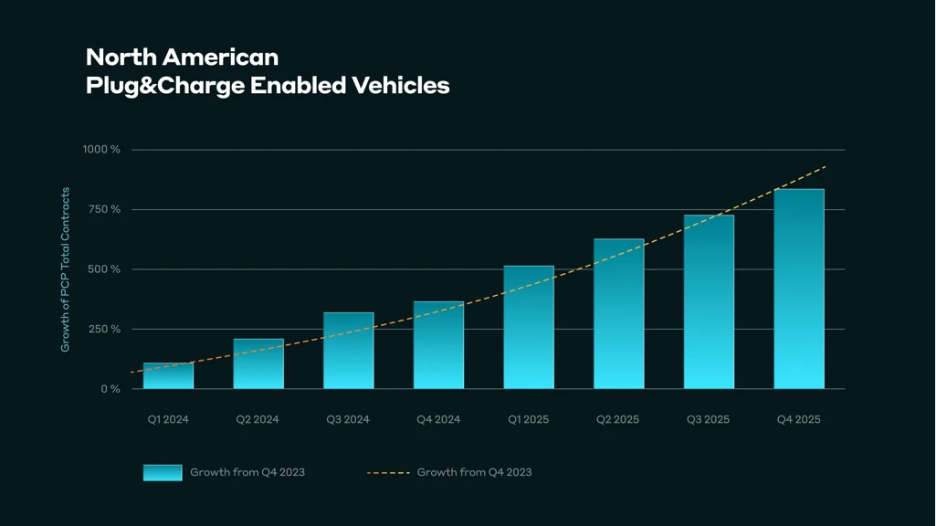
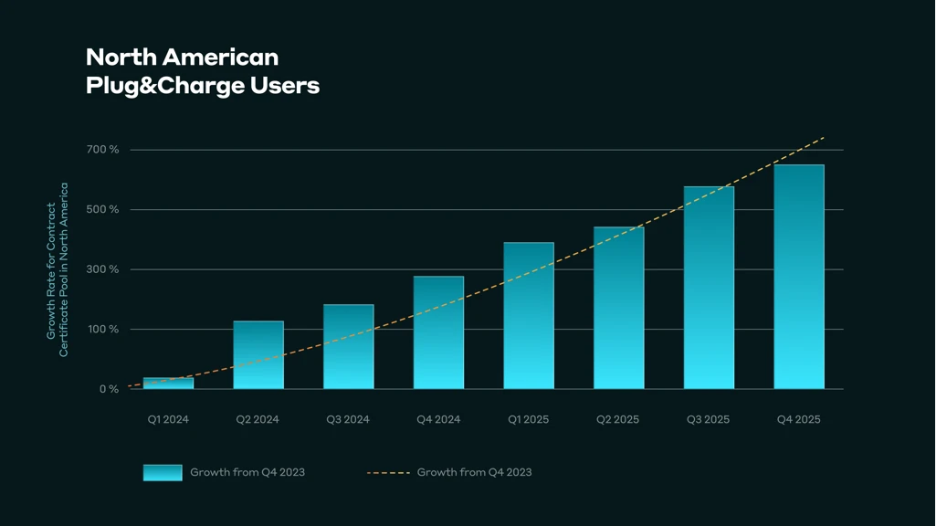
January 2026 marked 1 million Plug&Charge-enabled vehicles connected through Hubject's North American network. The growth trajectory tells the story: enabled vehicles in Hubject's network grew by approximately 800% from Q4 2023 to Q4 2025, while actual usage climbed roughly 650% over the same period. When given the choice between fumbling with apps or simply plugging in, drivers consistently chose the simpler option.
The momentum came from an unlikely alignment. Ford, BMW, Mercedes-Benz, Hyundai, Porsche, Lucid Motors, Volvo, Polestar, Nissan, Toyota, Blue Bird, and Rivian all committed to the same ISO 15118 standard. Electrify America, EVgo, Francis Energy, Blink Charging, Mercedes-Benz High Power Charging, Applegreen, Ionna, Lynkwell, ChargePoint, Shell Recharge, and more deployed compatible infrastructure. At the intersection of these networks, Hubject operates as the market enabler, providing the digital trust infrastructure that makes seamless authentication work across the ecosystem.
These partnerships delivered the charging experience drivers expected all along.
Three Emerging Applications
The 1 million vehicle milestone in Hubject's network tells one story. Three deployments in 2025 tell another: how seamless Plug&Charge extends into use cases that weren't on the roadmap two years ago.
Commercial Fleets Operating at Scale
PowerFlex became the largest charge point operator on the Hubject Plug&Charge network, with over 5,000 fleet chargers deployed and plans to reach 40,000 within two years. One deployment supports one of North America's largest last-mile delivery operations, where thousands of vehicles cycle through depot charging daily.
For commercial fleets, seamless Plug&Charge solved problems that manual authentication couldn't address at scale. When any supported vehicle plugs into any supported charger at the depot, it's instantly recognized. Fleet managers see exactly which vehicle is charging, which charger it's using, and which driver or account is associated with each session. This visibility supports accurate billing, cost allocation, and maintenance planning while ensuring route readiness.
The same authentication works when drivers charge away from the depot at public stations, partner sites, or approved home chargers. Every session links back to the fleet and bills correctly without additional cards or logins. Certificate-based authentication provides the security and reliability that mission-critical operations require.
Bidirectional Charging Enters Commercial Deployment
In June 2025, Hubject, Heliox, Accelera by Cummins, and Blue Bird delivered the first commercial deployment of an ISO 15118-20 compliant vehicle-to-grid solution. Electric school buses now draw power from the grid during off-peak hours and return energy during peak demand, creating new revenue streams while supporting grid resilience.
ISO 15118-20 enables secure bidirectional energy transfer alongside seamless Plug&Charge authentication. This deployment proved these capabilities work across different brands, systems, and use cases in real-world conditions. As grid demands increase and fleets transition to electric, vehicle-to-grid offers significant potential for load balancing, cost reduction, and energy resilience, particularly for high-utilization fleets with predictable charging patterns.
Public Charging Becomes Reliably Seamless
Ford reports that drivers using seamless Plug&Charge achieve a 99%+ charging success rate across the BlueOval Charge Network, which now includes access to over 25,000 Tesla Superchargers, IONNA stations nationwide, and more than 1,200 Ford-branded fast chargers at dealerships. ChargePoint announced in December that its entire current hardware portfolio supports Plug&Charge, positioning the network for expanded deployment in 2026. Mercedes-Benz High-Power Charging hubs launch with Plug & Charge active and reserved charging capability, reinforcing driver confidence that a compatible charger will be available and ready on arrival.
This infrastructure addresses what drivers consistently identified as friction points: knowing a charger will be available, confirming it will work with their vehicle, and completing payment without juggling multiple apps. Seamless Plug&Charge eliminates these steps entirely. Authentication and billing happen automatically through certificate-based communication between vehicle and charger.
What Changed
Three factors converged to accelerate adoption. Automakers committed to ISO 15118 implementation at scale rather than treating it as an optional feature. Charging networks invested in hardware and backend systems capable of supporting the standard. And Hubject, as a market enabler and central trust authority, provided the digital infrastructure enabling secure authentication across the ecosystem, issuing and managing certificates so every party could be validated.
The technical complexity of coordinating hundreds of market players across four key areas (charge point operators, eMobility service providers, vehicle manufacturers, and certificate authorities) previously slowed deployment. Alignment around a single standard rather than competing proprietary solutions changed this dynamic. ISO 15118 provided that foundation.
Regulatory momentum reinforced industry adoption. Starting January 1, 2027, support for ISO 15118-20 becomes mandatory in the EU for all new charging infrastructure. While North America lacks equivalent federal requirements, market forces are driving similar outcomes as automakers and networks recognize that fragmented authentication systems create competitive disadvantages.
What Happens Next
Reaching 1 million enabled vehicles in Hubject's North American network represents progress, not completion. The technology still faces challenges around certificate management complexity, infrastructure costs, and cross-network coordination. ChargePoint noted that scaling seamless Plug&Charge requires overcoming technical, commercial, and regulatory hurdles that vary across markets.
The growth trajectory shows these challenges are being addressed systematically. Quarter-over-quarter adoption rates show consistent acceleration as more stakeholders deploy compatible systems. The shift from pilot programs to commercial deployments across public charging, fleet operations, and bidirectional applications demonstrates that seamless Plug&Charge has moved from concept to operational standard.
The infrastructure exists. The vehicles are on the road. The authentication systems work reliably. What happens next depends on how quickly the ecosystem scales what's already proven to work.
Explore the full Plug&Charge ecosystem: See which CPOs, eMobility providers, EVSE manufacturers, and OEMs are enabling seamless charging across North America: https://www.hubject.com/ecosystem-overview
Ready to enable Plug&Charge for your network or fleet? Contact Hubject to explore how our Plug&Charge ecosystem can deliver seamless, secure charging experiences for your customers: hubject.com/contact
We will contact you to schedule a call and answer all questions you may have.
.svg)

